

Boeing's First Manned Space Flight Reaches International Space Station
Cape Canaveral, FL Boeing’s “Starliner” spacecraft finally docked at the International Space Station (ISS) on Thursday, June 6, after a series of launches and postponements as well as some complications that occurred.
The flight was delayed many times due to some reasons, and during this flight, a leakage of helium was detected, and there was propulsion trouble for some time. This compelled the astronauts to take control of the Starliner during the last stage of the of the flight towards the ISS, as said by NASA.
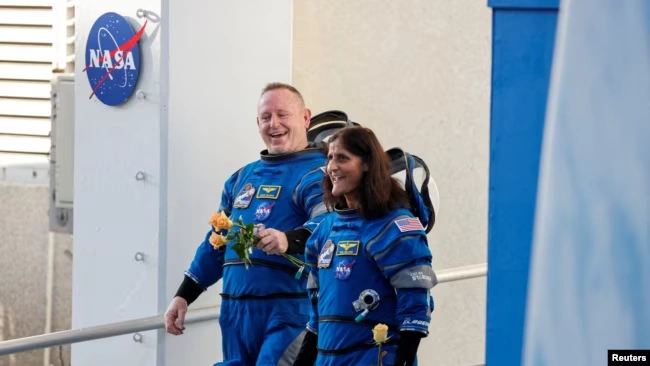
After the landing, both the new ISS astronauts aboard make their entrance to the station, ringing a bell and playing music and a funny ‘weightless’ dance to welcome the seven active astronauts of the station with hugs. Both space travelers are retired Navy captains, and they have made prior journeys to the ISS.
Specifically, Sunita Williams became the first woman to fly on such a test mission within the framework of the International Space Station program. Every time, she carries some Indian elements with her because of her Indian roots. This is her third trip to space.
Around a decade ago, Boeing and SpaceX, a company owned by Elon Musk, were hired by NASA to transport humans to the ISS. This was after the space agency NASA retired space shuttles. NASA paid Boeing $4.2 billion. The union spends about $2 billion, while SpaceX spends slightly above this amount to be paid for its services.
For instance, SpaceX has provided NASA with nine trips since 2020, while Boeing has offered two uncrewed test flights up until now. They had been scheduled for a crewed flight, but their tests were delayed by several technical issues.
Boeing’s initial uncrewed Starliner test flight in 2019 faced software problems, requiring a repeat before NASA could approve crewed missions. In 2022, a second test flight went better, though it still faced issues, including with the parachute.
The recent failed attempt, which occurred on June 5, 2024, was Boeing's third try with astronauts since the beginning of the last month. This launch followed other rocket issues, the latest of which occurred several days prior.
Boeing wants to have the Starliner attached to the ISS for at least eight days. Should this mission be successful, NASA will rely on Boeing and SpaceX to deliver astronauts to the space station and bring them home in the future.The Starliner was launched through an Atlas V rocket from the Cape Canaveral Space Force Station in Florida. It was the first time the astronauts employed the Atlas rocket since the space agency’s Mercury project in 1962.
Boeing plans to do six more missions of the Starliner for NASA and has announced that there will be a private option of a fifth seat in the spacecraft. SpaceX also offers rides as a commercial service to individuals and countries willing to send their people to the ISS for 6 weeks, but not for the 6 months with NASA.
